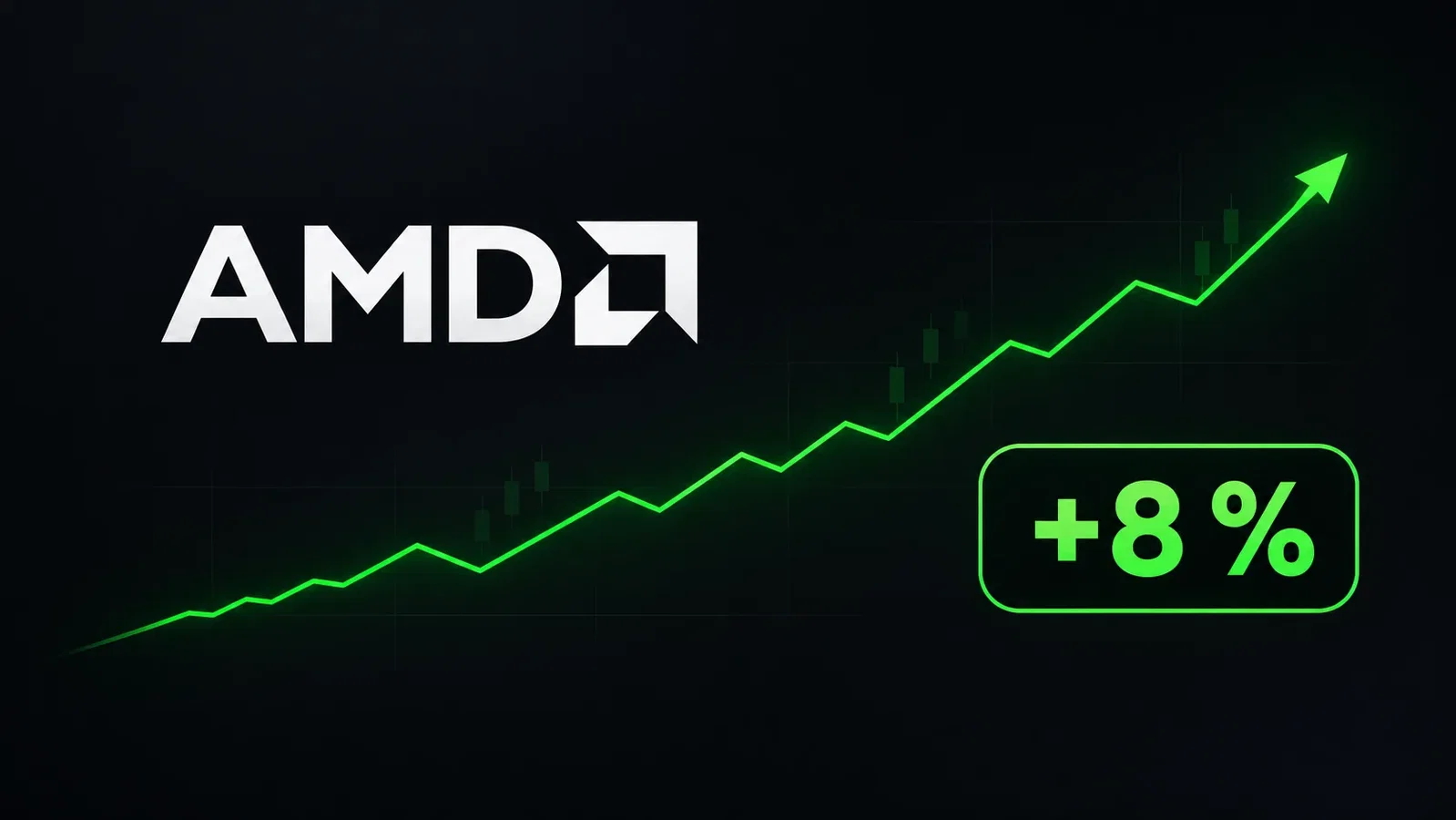
AMD Beats Expectations. Revenue Grows 45%. Shares Rise 8%.

$AMD beat expectations! Shares are up 8%. Revenue is growing 45%, and data centers are becoming a major part of the business. Stellar results, so let's get into it🚀
Revenue rose 45% year over year to a record $13.38 billion, while the data center segment nearly doubled its revenue. The company also beat analyst expectations and provided guidance indicating that growth is set to accelerate further toward the end of the year. Great news for all shareholders!
But the record itself is probably not the most important thing for them, even though it's the 16th in a row. AMD is gradually transforming into a technology company whose future will increasingly depend on the success of AI accelerators, server processors, and comprehensive data center systems. That's what will determine whether it can compete with Nvidia $NVDA over the long term and turn the current AI investment wave into steady profits.
Record results and significantly faster profit growth
Q3 2026 revenue
USD 13.38 billion
+45% year over year
Adjusted EPS
USD 2.09
+74% year over year
GAAP gross margin
54%
+2 percentage points
GAAP operating income
USD 2.83 billion
+123% year over year
Net income reached $2.43 billion, almost double last year's figure.
AMD can grow profits faster than revenue because higher sales volumes help spread the costs of development, marketing, and operations. That matters.
GAAP gross margin reached 54%, while adjusted gross margin was 56%. This shows that the company is gradually benefiting from a larger share of data center products, even as it invests heavily in new technologies. But it's no “hyperscaler” pouring hundreds of billions of dollars into investment, like $GOOG, which is starting to feel the strain.
The most important part of the results is clearly the Data Center segment, so let's take a closer look.
Segment revenue reached a record $8.5 billion, up 97% year over year, and accounted for approximately 64% of the company's total revenue.
Growth is driven by EPYC server processors and Instinct graphics accelerators.
EPYC processors help AMD win contracts from cloud providers and enterprise customers, while Instinct is a direct competitor to Nvidia's AI chips. The combination of these two product categories is AMD's strategic advantage.
The company is also expanding its offering from individual chips to complete systems. The Helios platform combines MI450 accelerators, EPYC Venice server processors, Pensando networking technologies, and the ROCm software platform. If that's hard to follow, no worries. The important thing is that AMD makes fast, increasingly faster products for data centers that compete with Nvidia.
With this, AMD offers customers not just computing power, but the entire infrastructure needed to train and run advanced AI models.
And that's pretty crucial if the business is to keep scaling. It's like Apple $AAPL. You build an “ecosystem,” and then build on it.
In data centers, it's not just the performance of a single processor that matters, but also power consumption, the speed of communication between chips, software compatibility, and total operating costs. If AMD can offer a competitive solution across all these areas, it can gain a more significant market share.
Strategic partnerships with the biggest players in AI
Partnerships with the biggest technology companies are the foundation for AMD's continued growth. Its customers and strategic partners include Microsoft $MSFT, Meta $META, OpenAI, and Anthropic (future ticker ANT). These companies are investing huge sums in AI infrastructure and are also looking for ways to reduce their dependence on a single chip supplier (Nvidia).
Let's take a closer look at the deal with Anthropic, announced in July, as it will soon go public.
The company plans to deploy up to 2 gigawatts of computing capacity based on AMD MI450 accelerators. The first gigawatt is expected to come online in the first half of 2027. AMD has also committed to a potential capital investment of up to $5 billion in Anthropic. Well, well - could this be another part of the circle?
Projects of this scale can of course secure long-term demand for the company, but they also create customer concentration risk. And there's also the possibility that Anthropic, for example, might not be able to pay for the things it has contracted for.
PCs, gaming, and industrial chips
While data centers are experiencing extraordinary growth, AMD's traditional segments are delivering mixed results.
The Client and Gaming division generated revenue of $3.7 billion. That's an 8% decline year over year.
The PC segment grew 7% to $2.9 billion, driven mainly by Ryzen mobile processors. AMD is taking on $QCOM here.
AMD is also benefiting from its competitiveness against Intel and its growing presence in laptops.
Gaming was significantly weaker. Revenue of $773 million represented a 40% year-over-year decline. This was due to lower revenue from graphics and custom chips, which AMD supplies, among others, to video game console manufacturers. Just think: a few years ago - not that long ago - gaming was “AMD's” biggest segment.
By contrast, the Embedded segment, which includes chips for industrial equipment, communications, and specialized systems, grew 29% to approximately $1.1 billion. This business gives AMD another source of revenue beyond the cyclical PC market. At least that's some diversification.
Fourth-quarter guidance surprised Wall Street
AMD's management expects fourth-quarter revenue of approximately $17 billion, with a 3% margin of error. The midpoint of the guidance represents year-over-year growth of approximately 66% and a quarter-over-quarter increase of 27%.
The company also expects adjusted gross margin of around 55%. Continued shipments of EPYC server processors and the ramp-up of production of the Helios platform are expected to be the main business drivers.
Financial strength and risks
AMD is entering its next phase of expansion with a relatively strong balance sheet. At the end of the third quarter, it had approximately $15.8 billion in cash and short-term investments.
Inventory rose from $7.9 billion to $11.5 billion since the end of 2025. Higher inventory may be related to preparations for expected AI chip shipments (the better-case scenario), but it also poses a risk if customers postpone orders (the worse-case scenario).
Nvidia is its biggest competitor. It has a significantly more developed CUDA software ecosystem, long-standing customer relationships, and a strong position in comprehensive AI systems.
AMD can't just offer powerful hardware. It also has to convince customers of the reliability of its software, the availability of its chips, and the cost-effectiveness of the entire infrastructure.
Shares are rising after the market close. And quite significantly, too. That's true, but thanks to Monday's drop, they haven't even recovered to the levels from the middle of last week. I don't have $AMD in my portfolio. I sold my shares after they rose above $200... Yes, I didn't catch the whole rally, but I still made a nice return. I captured the upside through options, so it worked out even better than with regular shares. I'm not currently considering opening a position.