Five biotech stocks that are not a lottery. They earn billions and await new drugs

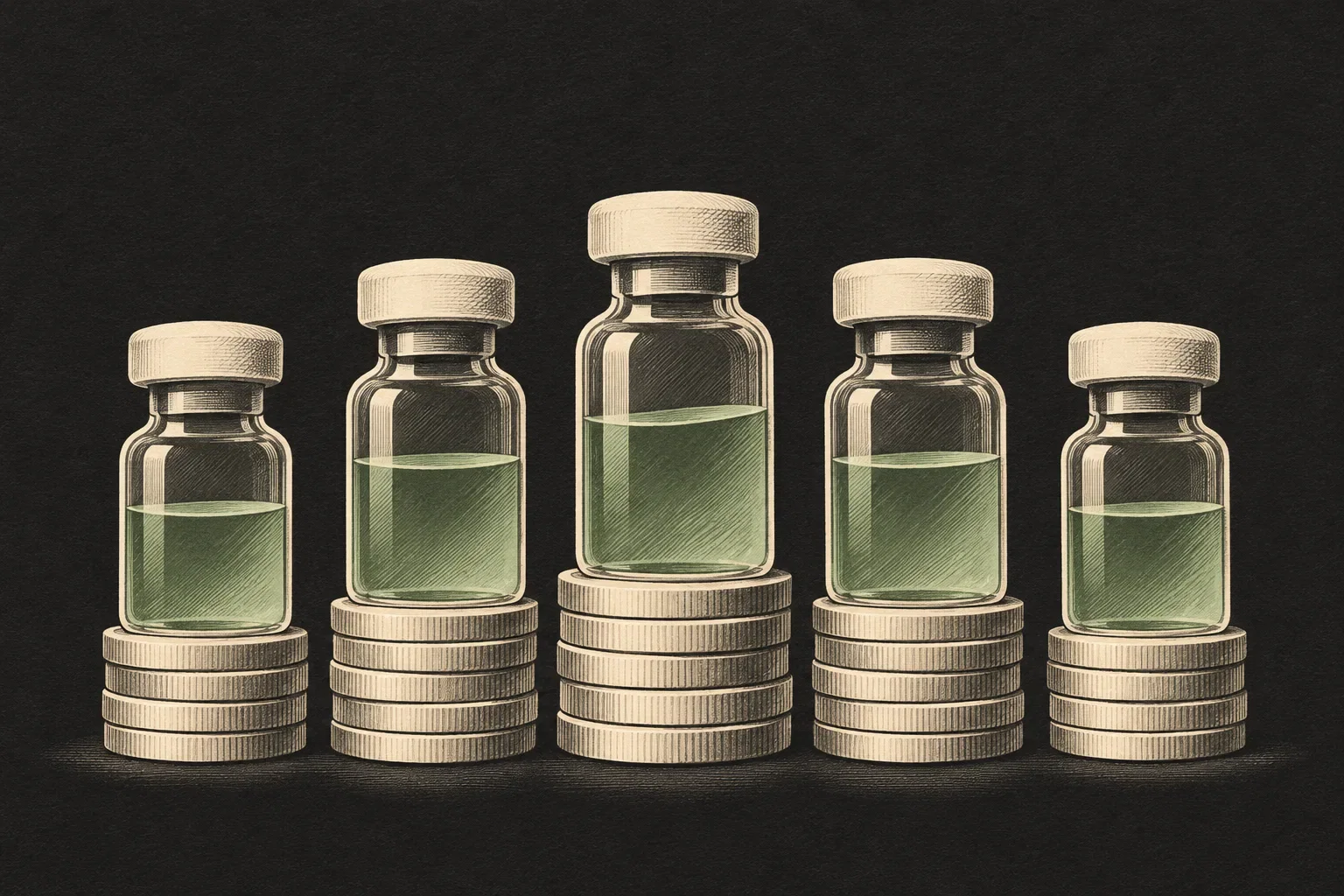
Biotech has a reputation for being a bet on a single drug that either succeeds or fails. But five companies, led by Amgen and Vertex, are already earning billions and soon face verdicts that could add another source of revenue.
Key points
Five biotech companies earn hundreds of millions to billions of dollars per quarter, and all are growing revenue.
Vertex awaits a U.S. regulatory decision on November 30 that could open a completely new market.
The smallest company in the group has seen its stock climb 78% from its annual low.
Amgen lost 45% of sales from one drug, yet overall revenue still grew.
All five companies share a weakness that is rarely discussed.
Biotech that is no longer a startup
When most people hear biotechnology, they imagine a small company with no revenue that spends investors' money for years and waits for the results of a single clinical trial. If the trial goes well, the stock soars. If not, it can lose most of its value in a single day.
But there is a higher league. Companies that have had drugs on the market for a long time, earn hundreds of millions to billions of dollars per quarter, and a new product is not a matter of survival for them, but of further growth. Five such companies have just reported third-quarter results, and all saw revenue grow: Vertex Pharmaceuticals $VRTX , Amgen $AMGN , Gilead Sciences $GILD , Exelixis $EXEL and Regeneron $REGN .
Company | Q3 revenue | YoY growth | What's next |
|---|---|---|---|
Vertex | $3.44 billion | +12% | November 30 FDA decision on kidney drug |
Amgen | $10.4 billion | +8% | late-stage trials of obesity drug MariTide |
Gilead | $8.3 billion (drug sales) | +13% | launch of new HIV drugs |
Exelixis | $659 million | +10% | March 3, 2027 FDA decision on colon cancer drug |
Regeneron | $5.1 billion | +36% | four successors to Dupixent |
Two dates investors are marking on their calendars
Vertex is closest to a major event. The company has long dominated the treatment of cystic fibrosis, a rare inherited lung disease, and it generates about 95% of revenue. Its newest drug Alyftrek alone brought in $706 million in the quarter, nearly triple last year's figure.
Vertex is therefore trying to diversify. It sells the non-addictive pain drug Journavx and the gene therapy Casgevy, and in September completed the acquisition of Crinetics for about $10 billion. In its quarterly results, it also reminded investors of the date November 30. By then, the U.S. Food and Drug Administration is expected to decide on povetacicept, a drug for a chronic kidney disease called IgA nephropathy.
"We are well positioned to make nephrology our fifth commercial area."
Reshma Kewalramani, CEO of Vertex Pharmaceuticals, during the Q3 earnings release
Vertex shares trade around $547 and have added about 21% since the start of the year.
Exelixis is the smallest of all five, with a market value of about $17 billion. The numbers from the quarterly report are all the more interesting: net profit of $218 million and $1 billion in share buybacks over nine months. About 92% of revenue comes from a single cancer drug, Cabometyx.
The second pillar is expected to be zanzalintinib, initially for patients with advanced colorectal cancer. The FDA extended its decision deadline by three months; the new date is March 3, 2027. Investors have so far forgiven the company: from an annual low of $39.71, the stock has climbed to about $70.70, an increase of 78%.
Two giants that add a dividend to growth
Amgen is the opposite of a company dependent on a single product. According to third-quarter results, sales of 17 drugs grew at a double-digit pace, and the same number earn over $1 billion annually.
Thanks to this, the company weathered a blow that would have felled a smaller player. The osteoporosis drug Prolia lost 45% of its sales after cheaper copies entered the market, yet total revenue still rose 8%. The gap was filled, among others, by the cholesterol drug Repatha, whose sales jumped 37% to $1.09 billion.
The biggest attention, however, is on MariTide, a weight-loss injection that is to be administered once a month or even less frequently. Several Phase 3, or final-stage, trials are underway. Meanwhile, shareholders receive a quarterly dividend of $2.52 per share, 6% higher than last year. The stock trades around $468.
Gilead is built on HIV drugs. Of quarterly sales of $8.3 billion, they accounted for $6.2 billion, 18% more than a year ago. Biktarvy remains the driver with $4.1 billion, but revenue from prevention products nearly doubled year-over-year. The company has also newly approved the tablet Bixlenvo.
Oncology is growing as well; the drug Trodelvy added 42% to $506 million. Thanks to this, Gilead raised its full-year sales outlook to $31.0 to $31.3 billion and pays a quarterly dividend of $0.82. There is one blemish: due to this year's acquisitions of smaller companies and their drug pipelines, the entire year 2026 will end in an accounting loss. The stock costs around $170.
Regeneron is growing fastest of all five
Not long ago, things looked bad for Regeneron. Its eye drug Eylea was losing patients to competition and the stock was falling. The original version continues to weaken, down 41% for the quarter to $400 million. But the newer Eylea HD with a higher dose added 62% to $699 million and nearly offset the decline.
The main engine, however, is Dupixent, a drug for eczema and asthma that Regeneron developed with French Sanofi. Its global sales rose 35% to $6.5 billion in the quarter. Total Regeneron revenue jumped 36% and adjusted earnings per share by 70%.
"It was an exceptional quarter for Regeneron; Dupixent, Eylea HD and Libtayo all achieved record sales."
Leonard Schleifer, CEO of Regeneron, during the Q3 earnings release
The company is also thinking about when Dupixent loses patent protection. In October, it expanded its collaboration with Sanofi by four next-generation molecules with longer-lasting effects. It will receive $1 billion immediately and up to $7 billion more for achieving milestones. Additionally, in November it awaits an FDA decision on cemdisiran, a drug for a rare muscle disease.
A weakness shared by all five companies
All five companies are connected by one more thing that is discussed less often. Each relies heavily on a single pillar:
Vertex: cystic fibrosis accounts for about 95% of revenue
Exelixis: Cabometyx generates roughly 92% of revenue
Gilead: HIV drugs make up three-quarters of sales
Regeneron: results driven by Dupixent and the Eylea family
That is why the upcoming dates are so important. They do not decide whether the companies survive, but whether they can build a second leg before the first one runs out of patents. And as the delay at Exelixis showed, regulators do not follow investors' schedules.
The second thing is price. Shares of Vertex, Amgen and Exelixis trade only a few percent below annual highs, so some good news is already priced in. But these five differ from a classic biotech lottery in the essential way: a failure of one drug will not bring them down, because research costs are covered by their own profits.